

I often get asked by my brother or friends why a stock might be down. As a stock market enthusiast, they expect me to just know why a stock is down. Much to their surprise, my answer is often, “I don’t know.”
In this article I will:
Give you a better framework of understanding why a stock is up or down
Help you stack bets in your favor (Meta as an example)
Stocks as a Bundle of Bets
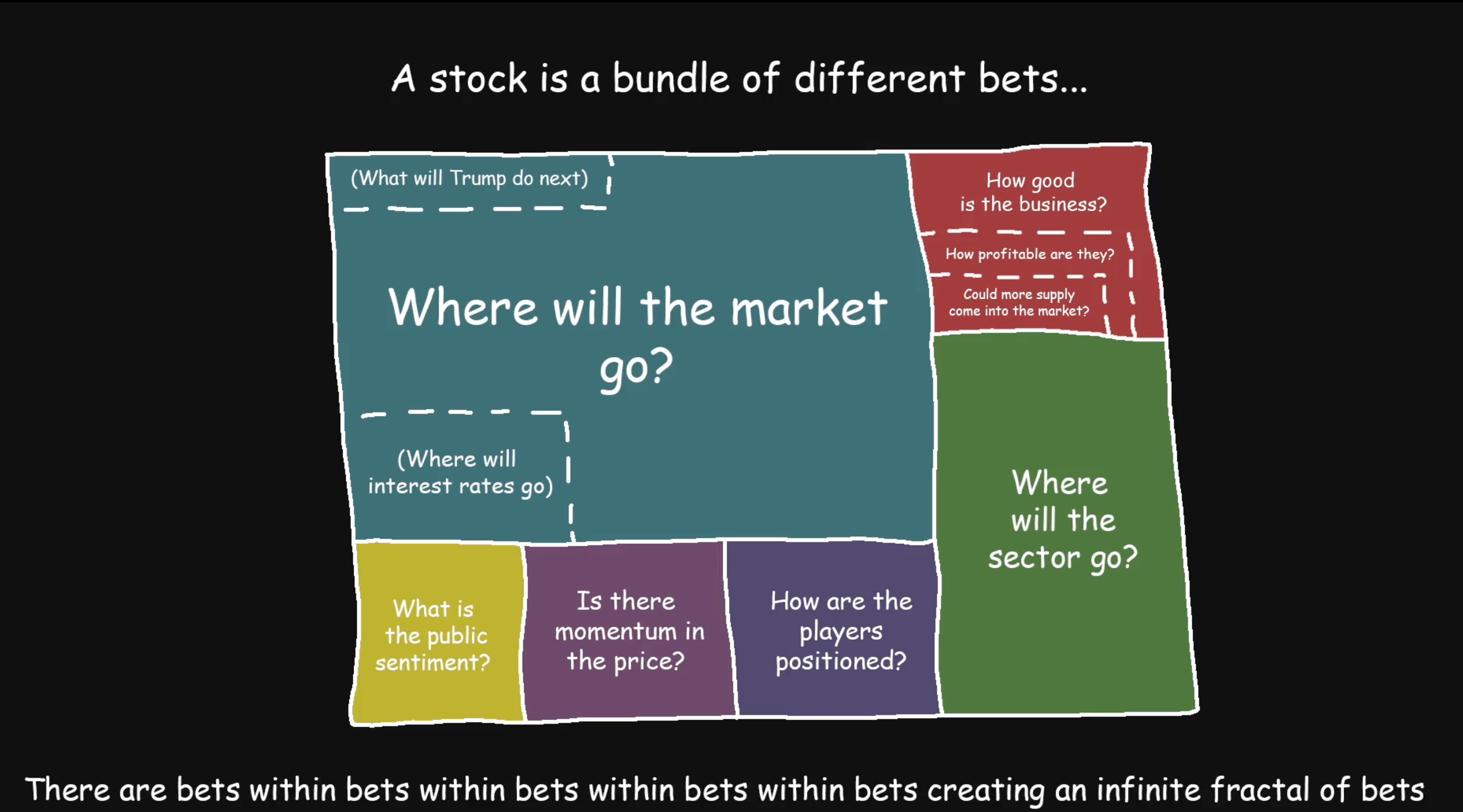
This graphic visualizes what comprises a stock and its risks. These subsections within a stock are not static in size, as sometimes the market can hone in on one factor or risk and that can drive the stock for a period of time. (see SaaS vs. Claude earlier this year)
Different stocks also contain different levels of each bet, as you can see a deep value cigar butt stock trades on its value, where an AI infrastructure company moves primarily with its sector. Over longer time frames, the value subsection typically grows in size, as the old Benjamin Graham saying goes:
“In the short run, the market is a voting machine, but in the long run, it is a weighing machine.”
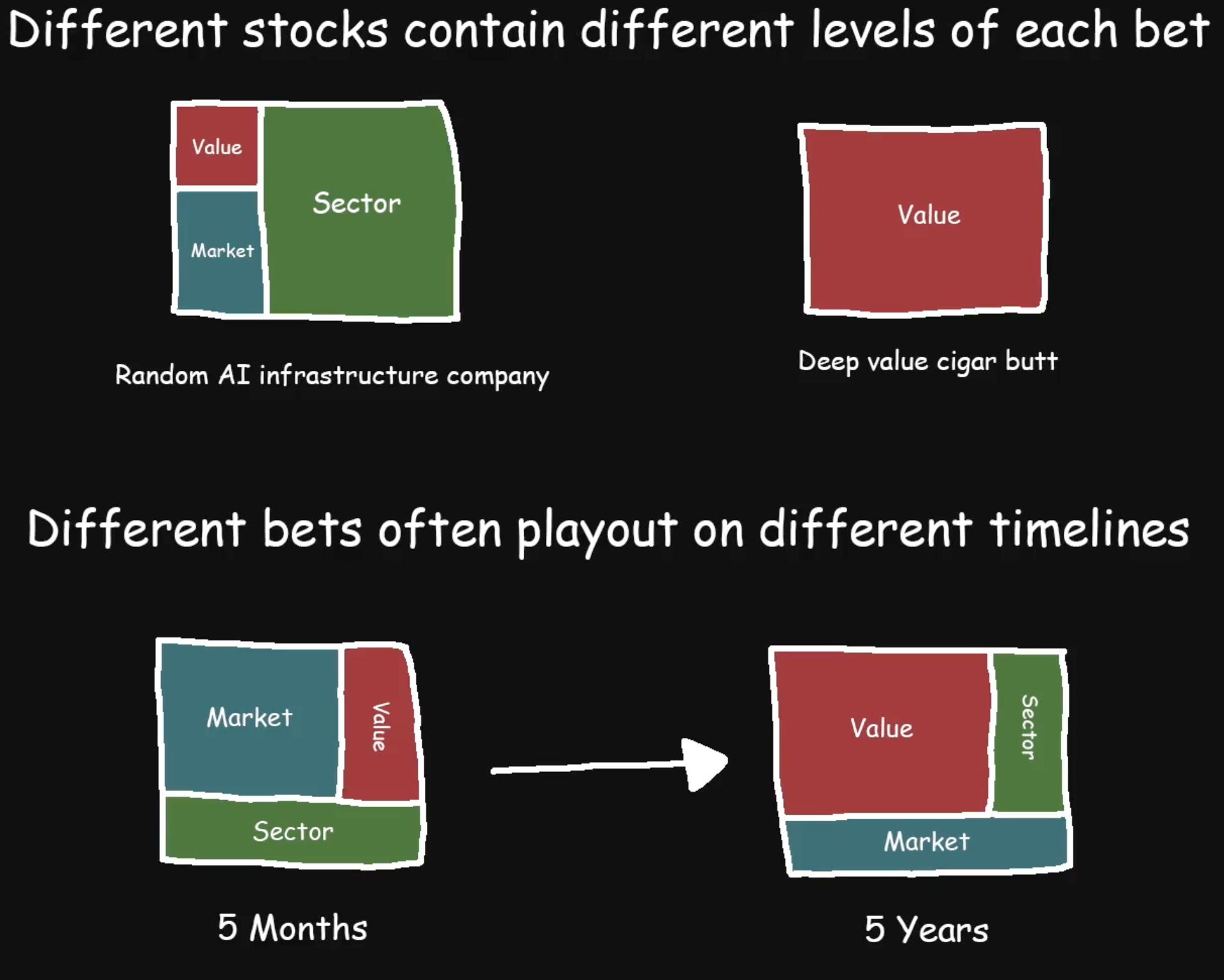
In shorter time frames, most of the move comes down to how the market is moving, not really stock specific bets.
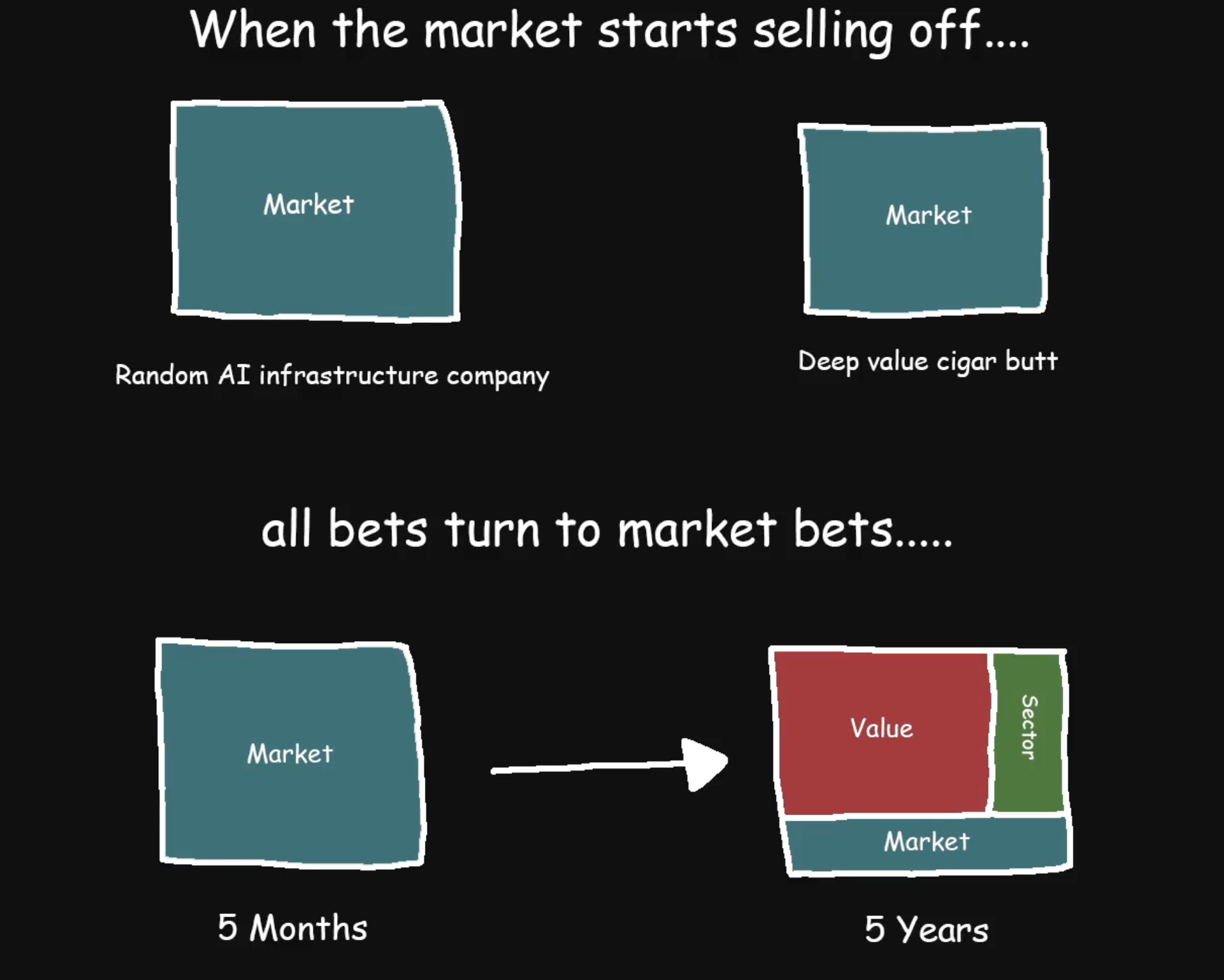
This phenomenon is why I prefer to invest over longer time frames. When so much of the market is moved by hard to predict factors (geopolitics or interest rates) it’s easier to take a longer lens and ask, “Will this company be around in 5 years? Will they sell more or less of their products? Will their investments pay off?”
Stacking Bets in Your Favor
Coming back to the original image, I think it’s important to consider all of these bets when entering a position:
For example, I have been really bullish on Meta for the past nine months. In that time, it sold off to the low $500s, and it became a hated stock, as it commonly does. I had a positive view on the business, its products, and growth prospects going forward. I also had a positive view on the sector as a whole, believing that hyperscalers would lead to the next leg up in the AI trade. (I still believe this)
All of this leads to me having a positive view on the business (red), sector (green), and market (blue) sections of the stock bet bundle.
In addition to that, the public sentiment was near all time lows. Mark Zuckerberg was getting clowned on like he had been for the Metaverse capital expenditures. This meant that there was no momentum in the price, and that most players were not long the stock.
It also meant that the yellow and purple sections (how players are positioned) worked in my favor, because when a stock is hated, it means many people don’t own it, and there are a lot of incremental buyers as positive news develops.
That’s what drove a rapid re-rate for Meta over the past month, as it’s currently up over 37% in that period.
Because Meta was so hated, when the sentiment shifts, as it has recently, the recovery is quite violent. This is similar to how Google was “behind in AI”, and “losing share in search because of ChatGPT” in 2025. We all saw how that played out.
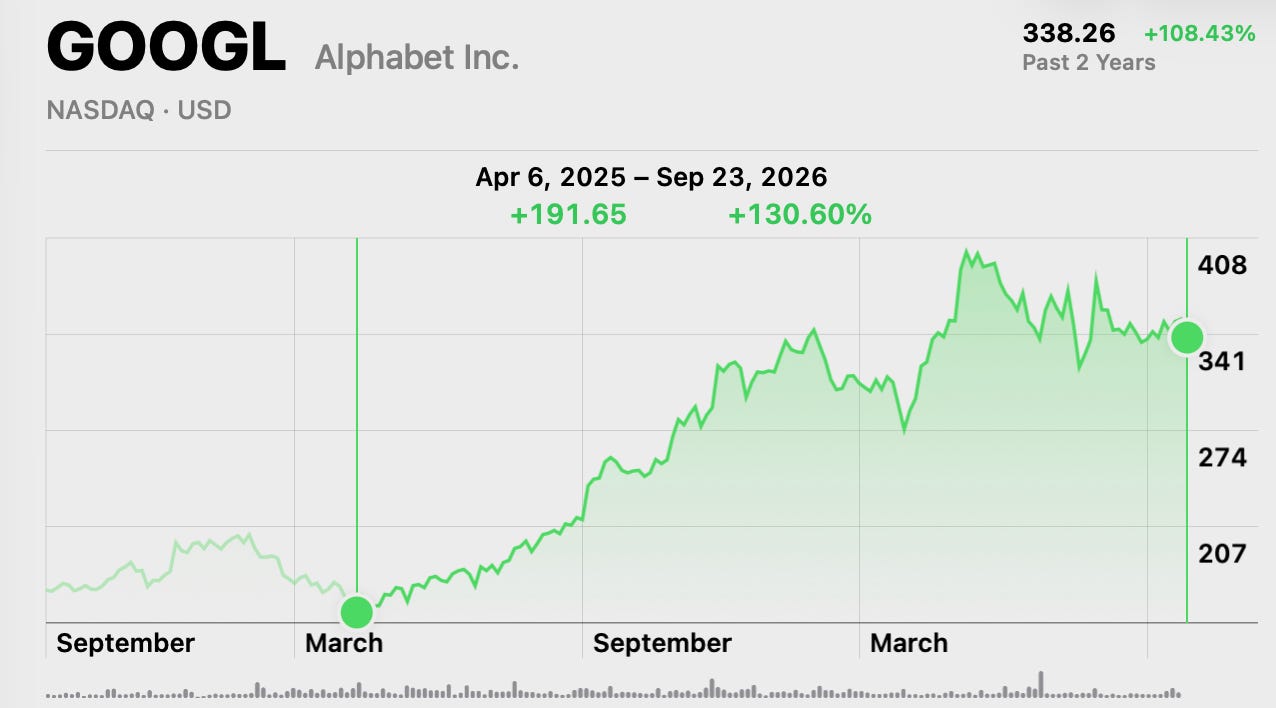
I don’t write this to brag about being long Meta in this time. It was an uncomfortable hold, and there were times when I doubted myself. I am still long Meta, but I recognize that now the bar for their execution has been raised as the stock has become more in favor with market participants.
I write this to highlight these two situations as examples of how betting against the consensus can be so rewarding.
Knowing Why Your Stock is Down
Back to my brother’s question. Most of the time, I still don’t know exactly why a stock is down. And I don’t think it’s that important to actually know, unless it has to do with your thesis.
If the broader market is down on geopolitics or rates, that doesn’t affect my longer thesis on Meta. If anything it can be an opportunity to buy more.
Now if Meta specifically is down on a negative headline, that would be something to dive deeper into, and assess whether it has any effects on my thesis.
All of this is to say, when you enter a position, try to stack as many bets as you can. Find a good stock, in a strong sector, and it’s even better if it’s a hated stock.

