

What I’ll go over today:
Why this opportunity exists
The improving economics of AI Capex & Datacenter Spend
Long Compute (via Oracle)
Why This Opportunity Exists
Oracle has recently become something of a battleground AI stock, for a few reasons:
A few months back, Oracle’s 5-year CDS went from roughly 145 bps to ~215 bps, a ~70 bp increase. A CDS is essentially insurance against Oracle defaulting on its debt. So if you own Oracle bonds, you can buy a CDS that pays out if Oracle defaults. When that insurance gets more expensive, the market is pricing greater credit risk.
In simple terms, the market was saying that Oracle has become much riskier to lend to. The Kobeissi Letter@KobeissiLetterInvestors are worried about Big Tech's debt. Oracle's, $ORCL, 5-year credit default swap (CDS) has surged +70 basis points year-to-date, to a record ~215 basis points, the largest increase among Big Tech companies. This is followed by Broadcom, $AVGO, whose 5-year CDS has risen …
 4:11 PM · Aug 8, 2026 · 269K Views129 Replies · 239 Reposts · 1.72K Likes
A ballooning Remaining Performance Obligations figure. Their RPO has grown 46% YoY, and Oracle is also claiming that they will turn 50% ($332b) of that into revenues over the next 3 years.
 Fiscal.ai@Fiscal_aiOracle Q1'27 Results Revenue: $19.3B vs. $19.1B (Beat 🟢 ) +30% YoY EPS: $1.92 vs. $1.74 (Beat 🟢 ) +30% YoY RPO: $664B +46% YoY Cloud Revenue: $11.6B +62% YoY $ORCL
 9:00 PM · Sep 10, 2026 · 13.2K Views3 Replies · 13 Reposts · 111 Likes
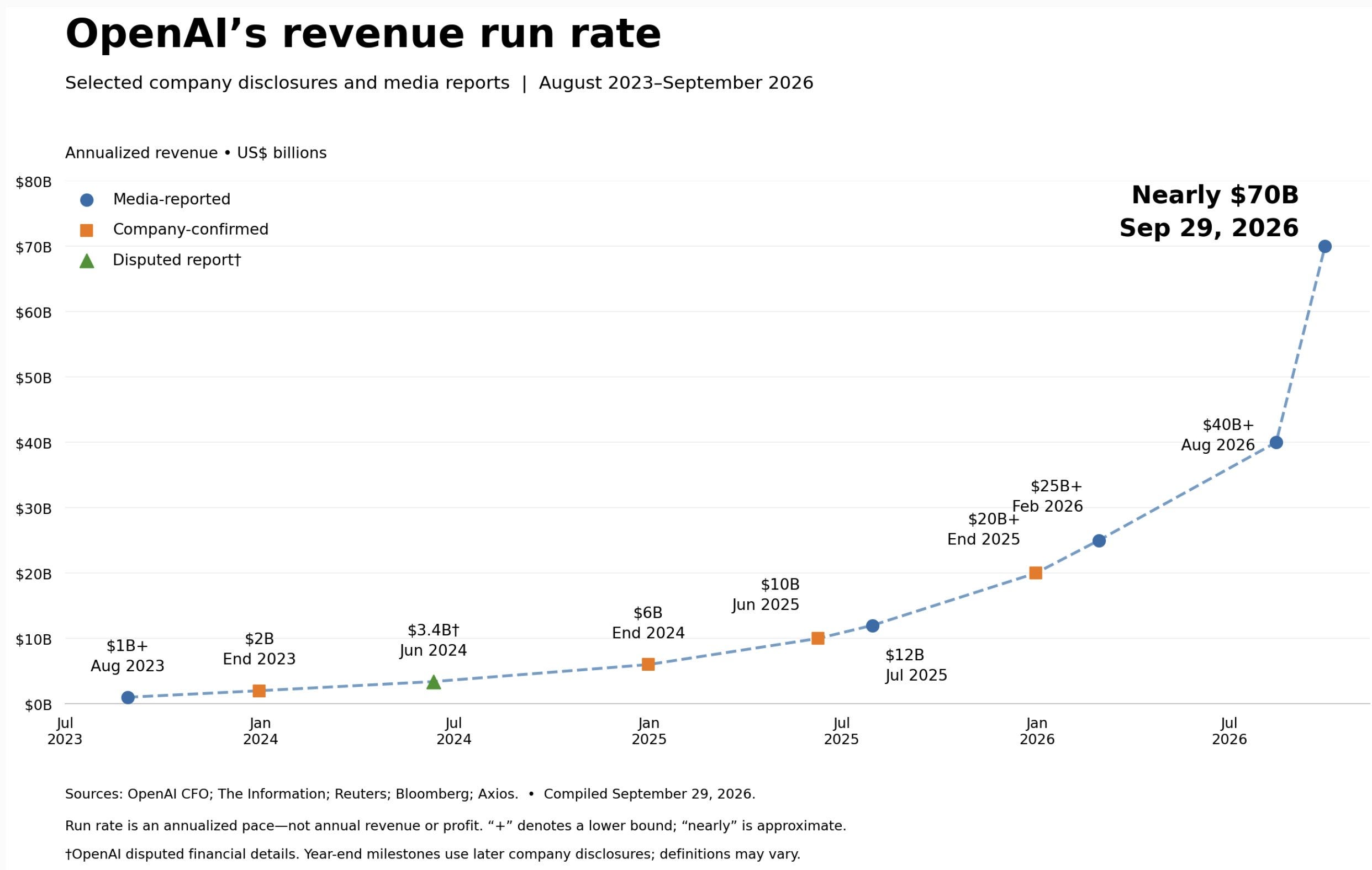
Concentration risk to OpenAI. ~45-50% of their RPO is contracted with OpenAI. People draw comparisons of this AI buildout to the dot-com bubble, and there is fear that having so much revenue tied to one customer could cause Oracle’s demise.
Force Majeure notice on Project Jupiter: Last week, Oracle sent a force majeure notice to the developer of Project Jupiter, its Stargate data center in New Mexico built to serve OpenAI. In plain terms, the notice lets Oracle push back lease payments if the site misses its 2028 target, which is looking likely given the power and permitting delays. The stock dropped 3% on the news. For me, this read more like a timing thing, not them walking away from the site. They are just covering their liabilities if there is a gap in payment timelines.


For these reasons, Oracle has become somewhat of a dog in the AI trade. Where other compute providers (CRWV, NBIS) have rallied, Oracle has stalled, and in fact it’s down ~55% from its 52wk high.
I honestly think ORCL is one of the simplest longs in the market. To like the stock I think it comes down to a few beliefs you have:
Compute is valuable
AI usage is only going to increase over time
Concentration risk does not matter. Even if OpenAI were to go bankrupt (low probability), that compute can be sold to another AI lab (Anthropic, Google, Meta, etc.)
Agentic AI unlocks a previously underrepresented customer for AI, the consumer. This demand could be another major driver of compute consumption over time, irrespective of which agentic product wins (Muse, Grok Bot, Instinct, Dots, etc.)
With those beliefs it’s easy to underwrite the bull case. What’s particularly interesting to me is that if you look at semis/proxies for the AI bet, the implied sentiment around the AI trade seems positive right now. All except for Oracle.
What this means is that a lot of players are offsides, and there are many incremental buyers of Oracle as these fears dissipate.
Right now I think the market is being a little myopic on Oracle. They see one major customer and are scared of concentration risk. I see strong demand, evidence that older hardware retains earnings power, and revenue that will far supersede the cost of capital on these infrastructure investments.
I believe the increase in WACC of these hyperscalers is more so a function of the sheer scale of how much capital they need to fund this buildout, not an indictment on the feasibility of these investments.
Capex Validation: Hyperscalers are Seeing Improved Economics on AI Spend
Before we move into valuation and how much upside I think there is in Oracle, I want to go over some quick data points that serve to validate Oracle and other hyperscalers’ capital expenditures.
GPU rental rates are increasing
 Beth Kindig@Beth_KindigOracle: “Of all the GPUs that came up for renewal in Q1, that capacity was renewed or resold at a 20% premium to prior contracts. The majority of those GPUs are 4 years or older.” $ORCL $NVDA $AMD4:03 PM · Sep 17, 2026 · 39.2K Views8 Replies · 27 Reposts · 265 Likes
GPU depreciation schedules are longer than the AI skeptics have assumed
 Ornn@OrnnExchangeThe H100 is a three-year-old training chip. Its rental price is up 22 percent on the month, to $3.28 an hour. Every depreciation schedule assumes a chip this old only loses value. The market is paying up for it instead.
 6:40 PM · Sep 7, 2026 · 1.27M Views74 Replies · 96 Reposts · 1.41K Likes
Amazon is saying their payback period on a datacenter is 3 years!
 AustinFindsAlpha@AustinsStocks@A_Hollywood1776 @porterstansb Andy Jassy "Servers and networking equipment run on a shorter cycle... Those take a little under three years to break even against a useful life of at least five to six years." "Data centers require capital about two years before servers can be installed and start generating…12:19 AM · Aug 12, 2026 · 189 Views1 Reply


All of these developments lead to an environment where the market should appreciate existing compute as well as current investments in expanding compute capacity.
I say should because for some companies it already has; see MSFT as an example. From the recent broader AI unwind in late July, MSFT is up over 30%.
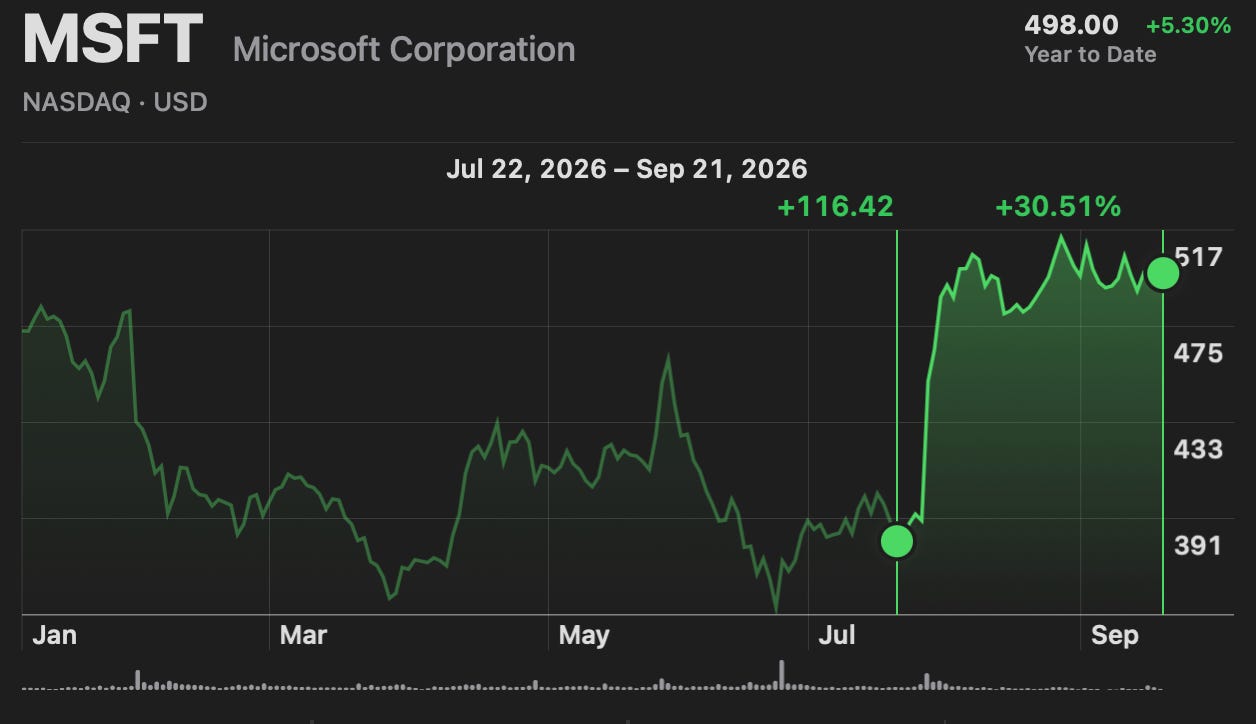
I believe this trend will only continue, as the market begins to appreciate heightened capital expenditures, even at the cost of near-term FCFs.
Michael Mauboussin recently wrote a great piece on FCF, ROIC vs. WACC, as well as ROIIC (Return on Incremental Invested Capital), which adds more color to this thesis.
One of my main takeaways was that on a relative basis, Oracle will have the largest improvement on their incremental invested capital.

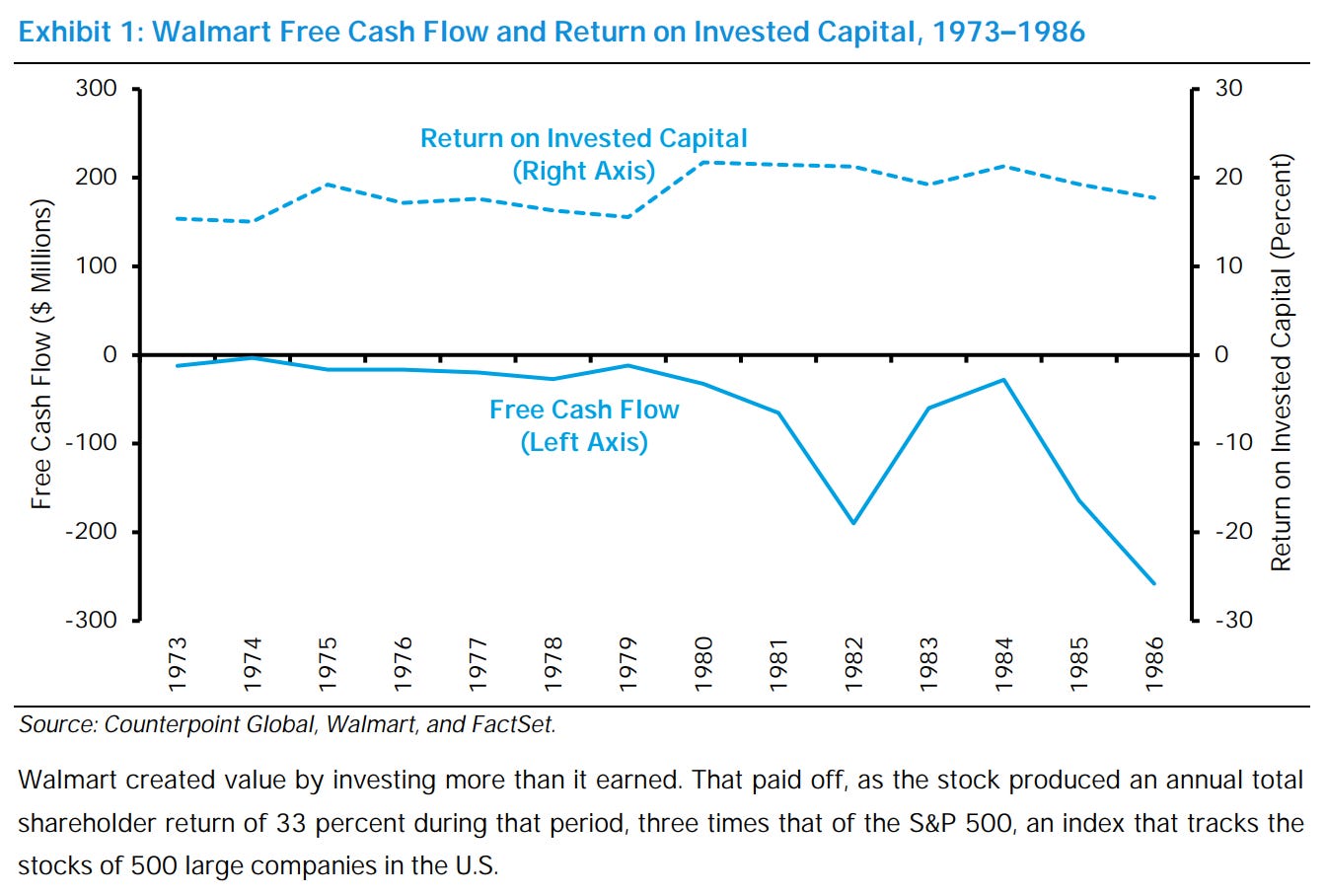
On longer time horizons, returns on invested capital ≈ returns on stocks. With this in mind, we should ideally buy stocks in companies that are making positive capital investments.
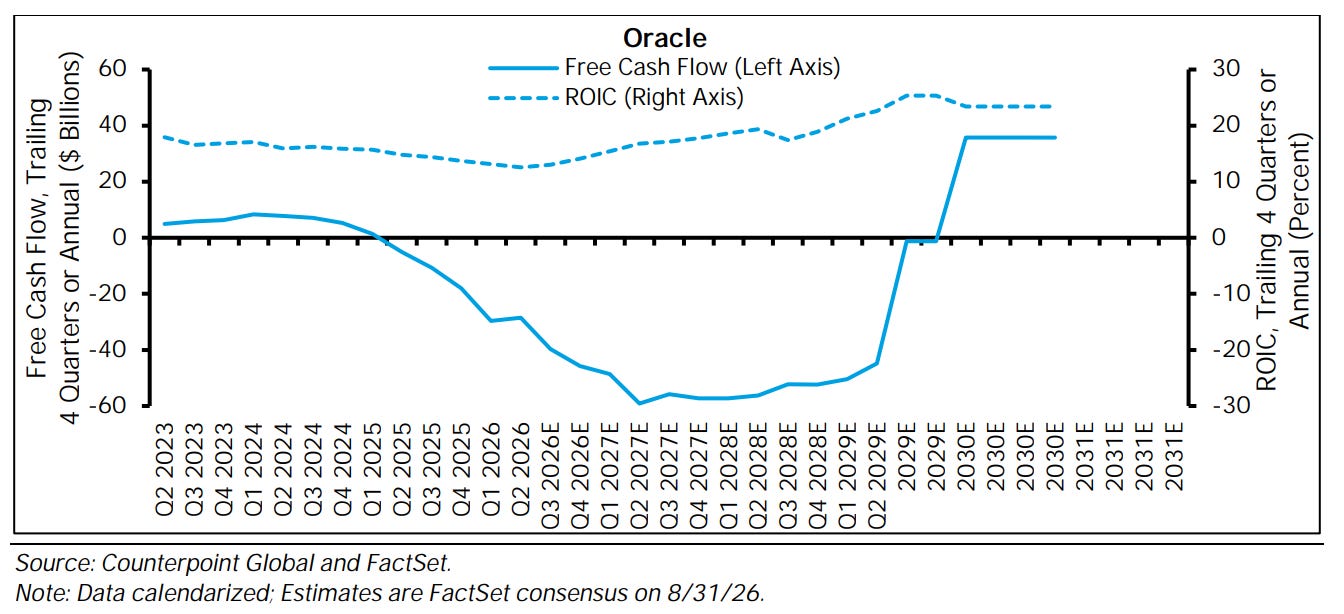
While near-term FCF looks dire, taking a longer lens we can see that their ROIC profile remains strong, and that these major investments seem likely to pay off given the developments in GPU prices that I highlighted earlier.
Michael Mauboussin highlights a good example of how burning FCF in the name of investments can make for exceptional returns with Walmart:
On top of all of this, Larry Ellison is closely tied to the Trump admin, and if we were to see any analogues to the “Too Big To Fail” in this AI investment cycle, it seems likely Ellison could be one of the beneficiaries.
Additionally, if OAI concentration risk is the primary Oracle bear case, is their recent acceleration to a $70B ARR not dispelling that?
Investment Thesis
The investment case here is pretty simple: Oracle turns its contracted demand into rapidly growing revenue and earnings, and the stock re-rates as they deliver on that story.
Oracle’s long-term financial outlook targets $130 billion of revenue in FY2028, $185 billion in FY2029, and $225 billion in FY2030, alongside non-GAAP EPS of $10.65, $16, and $21, respectively. These are management targets, but they show you the scale of the earnings opportunity if Oracle executes.
There is already evidence of that conversion. In Q1 FY2027, infrastructure revenue grew 121% to $7.4 billion, supported by 850 MW of additional delivered capacity. Oracle also raised its FY2027 revenue outlook to at least $90 billion. The story is already progressing from signed contracts into operating revenue.
Bull, Base, Bear Cases
If we assume for a second that management hits on these targets, and FY2030’s EPS is ~$21, and the stock trades at 20x earnings, we get a stock price of $420 in mid-2030. At a 10% discount rate, that backs out to a fair value of $295 today, so over 2x upside from today’s levels.
If we lower our assumptions, say to 2030 EPS of $15, so 70% of their targets, and an 18x multiple, we get $270 or roughly $190 discounted back to today.
If we cut management’s figures in half, and say they only get $10 of EPS by 2030, assign a 15x multiple to that, we get $150 which is worth about $105 today.
So baking these all in, we have a ~2x on the bull case, +38% on the base case, and -24% on the bear case. That seems like a palatable risk profile even if you assign a high likelihood to the bear case, which I do not.
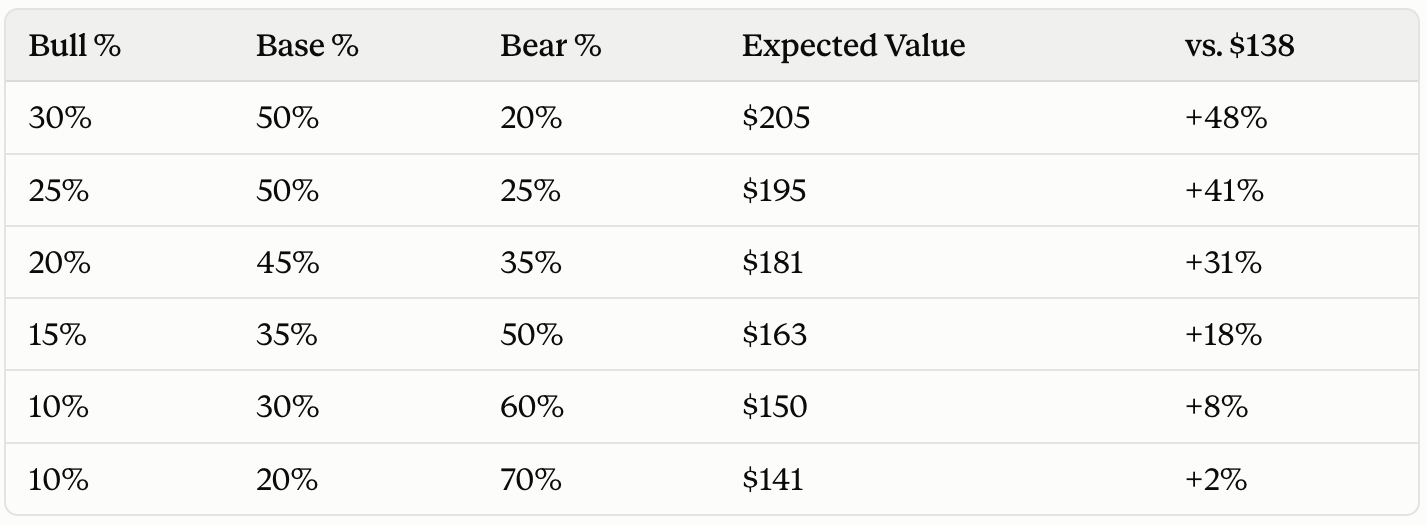
To be clear, I don't think it's a foregone conclusion that they perfectly hit $21 of EPS in fiscal year 2030. I used that as a framework for backing out to today's prices and building an investment case. I think there are many scenarios where they far exceed that $21 of EPS and others in which they do not. Additionally, in 2030, if they hit on $21 of EPS it’s entirely possible a 20x earnings multiple is too conservative. It all comes down to your beliefs on the validity of these investments in AI infrastructure.
The Trade
I am invested in ORCL via common stock as well as longer dated call options. I have December 2027 calls struck at $230/share to play a more aggressive re-rating, but I also have LEAPS for December 2028 struck at $160/share.
The $230s are a bet that the re-rate comes much faster than I expect, and I sized it much smaller because I view it as much less likely. The common stock and $160 LEAPS are the true reflection of my investment case.
I do not foresee any near-term catalysts that will change the market's view. I believe they must execute and deliver on the buildout, and the market will appreciate it when the revenues and growth come.
Disclaimer:
I hold investments in Oracle
This is not financial advice, do your own due diligence before making any investment decisions.
Enjoyed this article? Consider subscribing, leaving a comment, or checking out my most popular posts:
META: Social Media's Big Tobacco Moment?

$META is back below $550 ($525 at the time of writing this) for the first time since the April tariff scares of last year — despite significant financial improvement since then:
Commodity Futures Are Simple, Actually

Last Fall, I sat down in my Derivatives class fully expecting to feel like I did in AP Calculus back in high school. In over my head, totally confused, etc.