

I texted my brother and his friend about Robinhood on August 20th. Since that text, it's up about 30%. Maybe I should take Druckenmiller's advice, "invest first, investigate later."
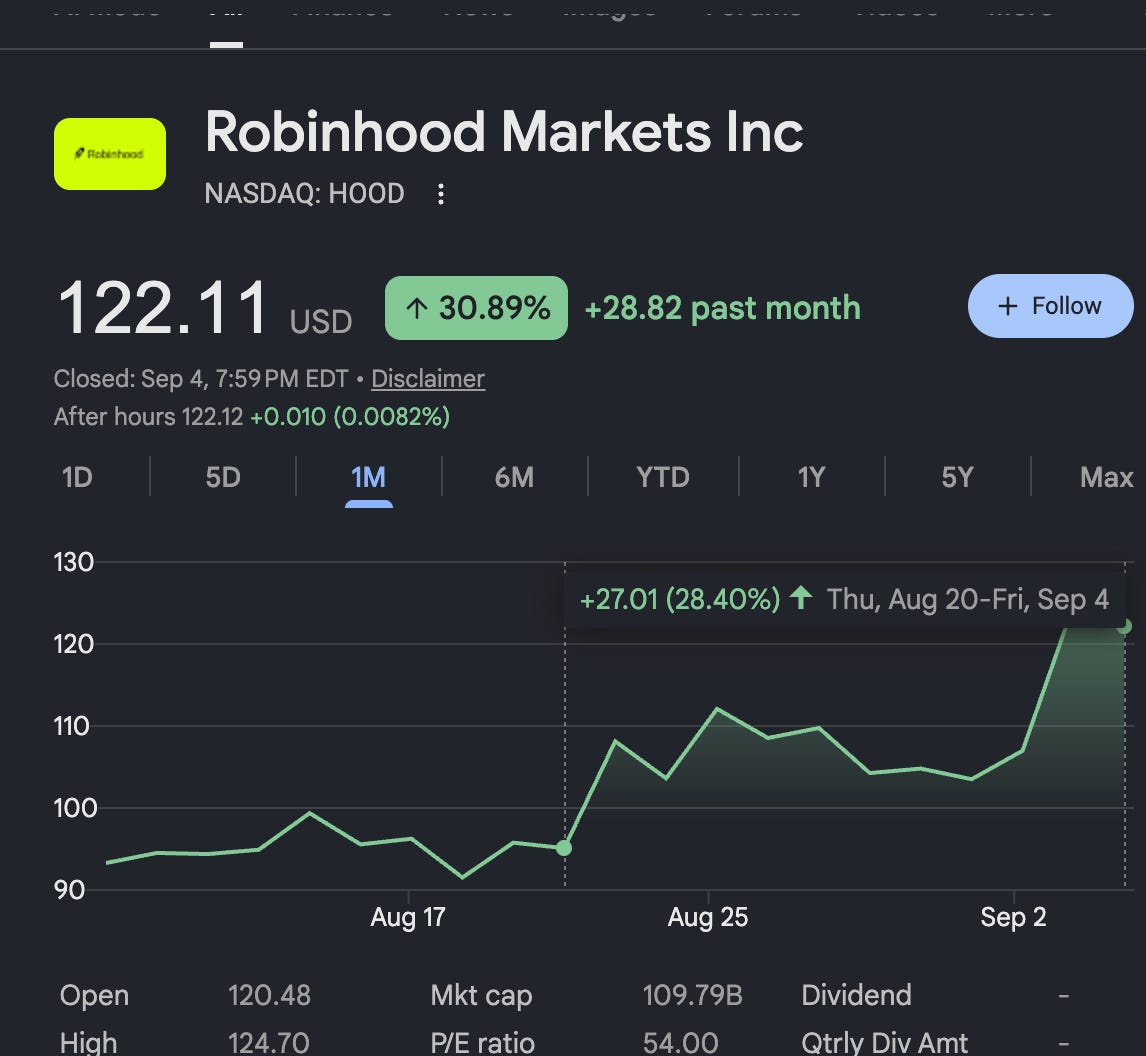
Now at ~$120, and a $110 billion valuation, I have to determine if that price is worth paying. I am a believer in what they are doing, offering higher interest rates than peers on uninvested brokerage cash, targeting younger customers, and growing a substantial subscription base for Robinhood Gold. On top of that, they offer a great credit card, are rolling out access to bank accounts, and plan to offer mortgages eventually.
The Business
To me, Robinhood is a very compelling fintech company. Apart from the 2021 GME crisis, I think they have done a great job, and their product lineup covers most of what a retail investor wants. They’ve become a mostly one stop shop for taxable, retirement, and managed accounts. In addition to all of these accounts, they make passive investing frictionless, and their Robinhood Gold is a steal at $5/month. They are even growing a social media on the side. (You can follow me at NPV on Robinhood Social.)

These highlights fail to mention what they already do in crypto, prediction markets, and whatever tokenized stocks are used for. I mentioned these last because while they contribute to their revenue (for prediction markets, pretty substantially,) I do not rate them as part of my longer term investment thesis for a few reasons:
Crypto is wildly cyclical, incredibly volatile, and I’m just not a major believer long term.
Prediction markets seem ripe for regulation in upcoming election cycles.
I haven’t seen a compelling enough use case for tokenized stocks to assign them meaningful value in my thesis.
Revenue Breakdown
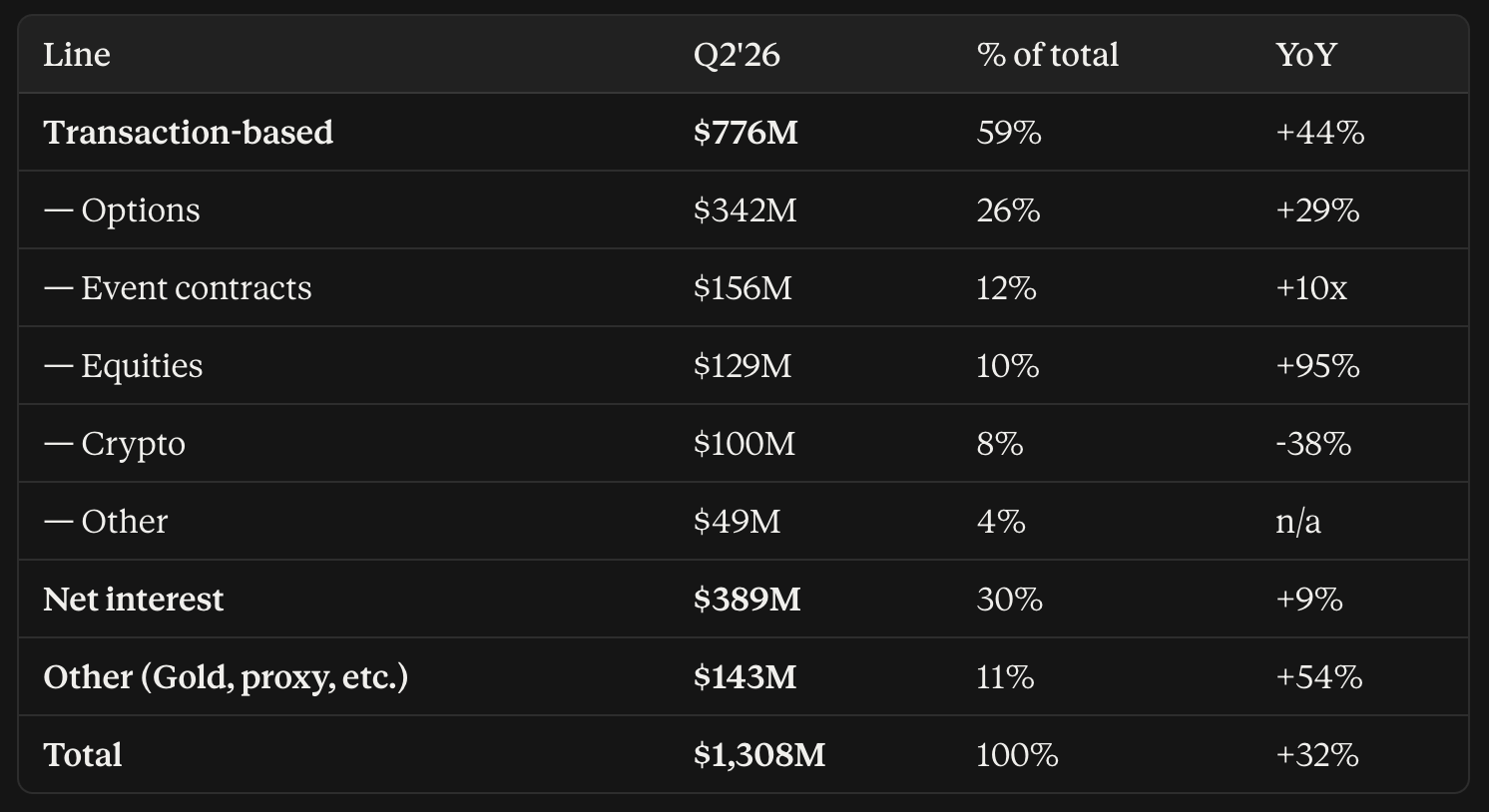
Notable highlights from this include:
Event contracts revenue up 10x YoY
Equities revenue up 95% YoY
Robinhood Gold specific rev (the most sticky in theory) works out to $54M
Gold subscribers are up 39% YoY
Options and equities generated roughly 36% of revenue this quarter. Add net interest income and Gold subscriptions, and that reaches about 70%. These are the businesses I’m more comfortable building a long-term thesis around, although I wouldn’t assume this quarter’s earnings power holds through every market environment.
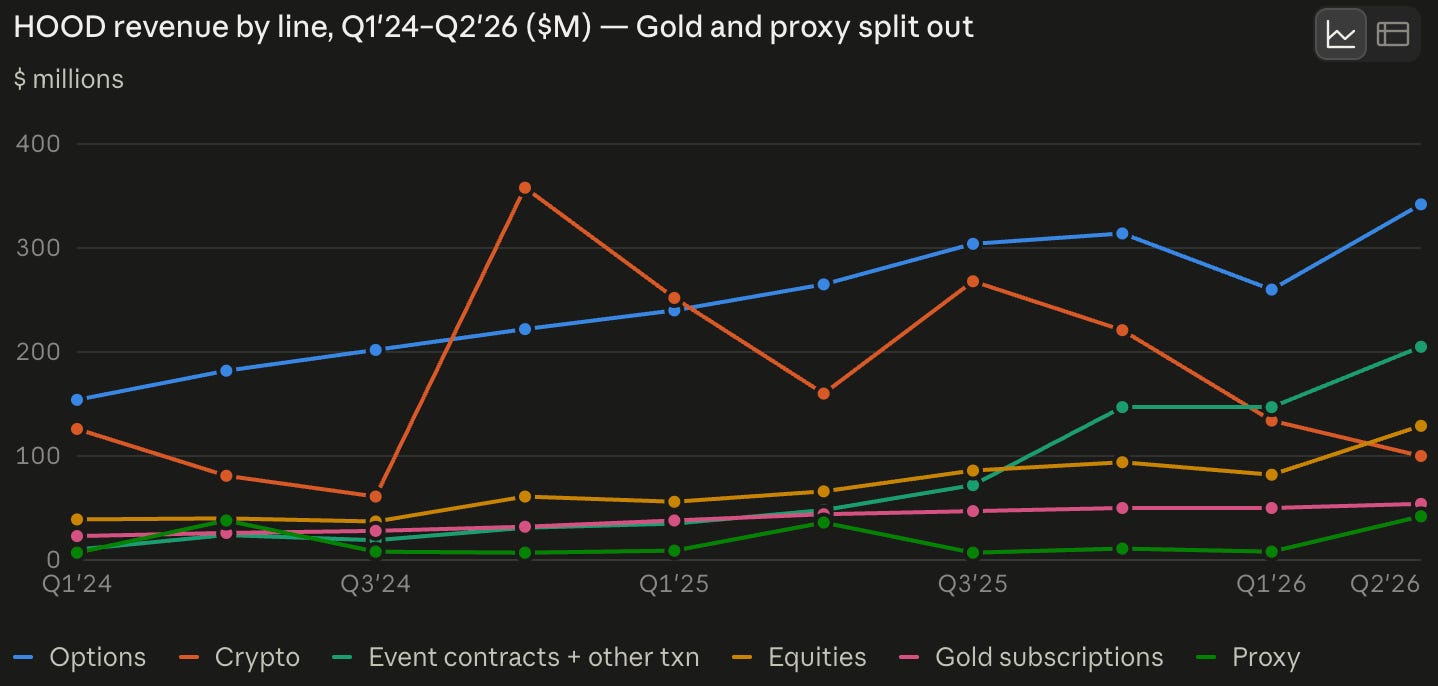
Robinhood’s Growth Engines
My investment thesis is that Robinhood can retain customers as their incomes and portfolios grow, and convince them to bring more of their financial lives onto the platform. There’s already clear evidence of this, with funded customers growing 7% YoY and Total Platform Assets growing 32% to ~$369 billion. Over the past 12 months, Robinhood brought in $75.7 billion of net deposits, equivalent to 27% of platform assets at the beginning of that period.
I view Robinhood Gold as another growth vehicle for them, as approximately only 17% of funded customers are Gold subscribers. That compares with 40% of new funded customers signing up for Robinhood Gold. That suggests to me that there is room for adoption to increase, especially as to fully pay for your Gold subscription at current interest rates, you need just under $2,000 in brokerage cash.
I could easily see Gold becoming an Amazon Prime-esque membership, where it’s a subscription that is far more sticky than others.
More assets are great, but they don’t automatically convert to proportionally more revenue. All else equal, Robinhood aims to attract customers who have more assets, but also who trade more. Higher trading activity in options, equities, and prediction markets is what Robinhood really wants. It seems like they’ll get it too.
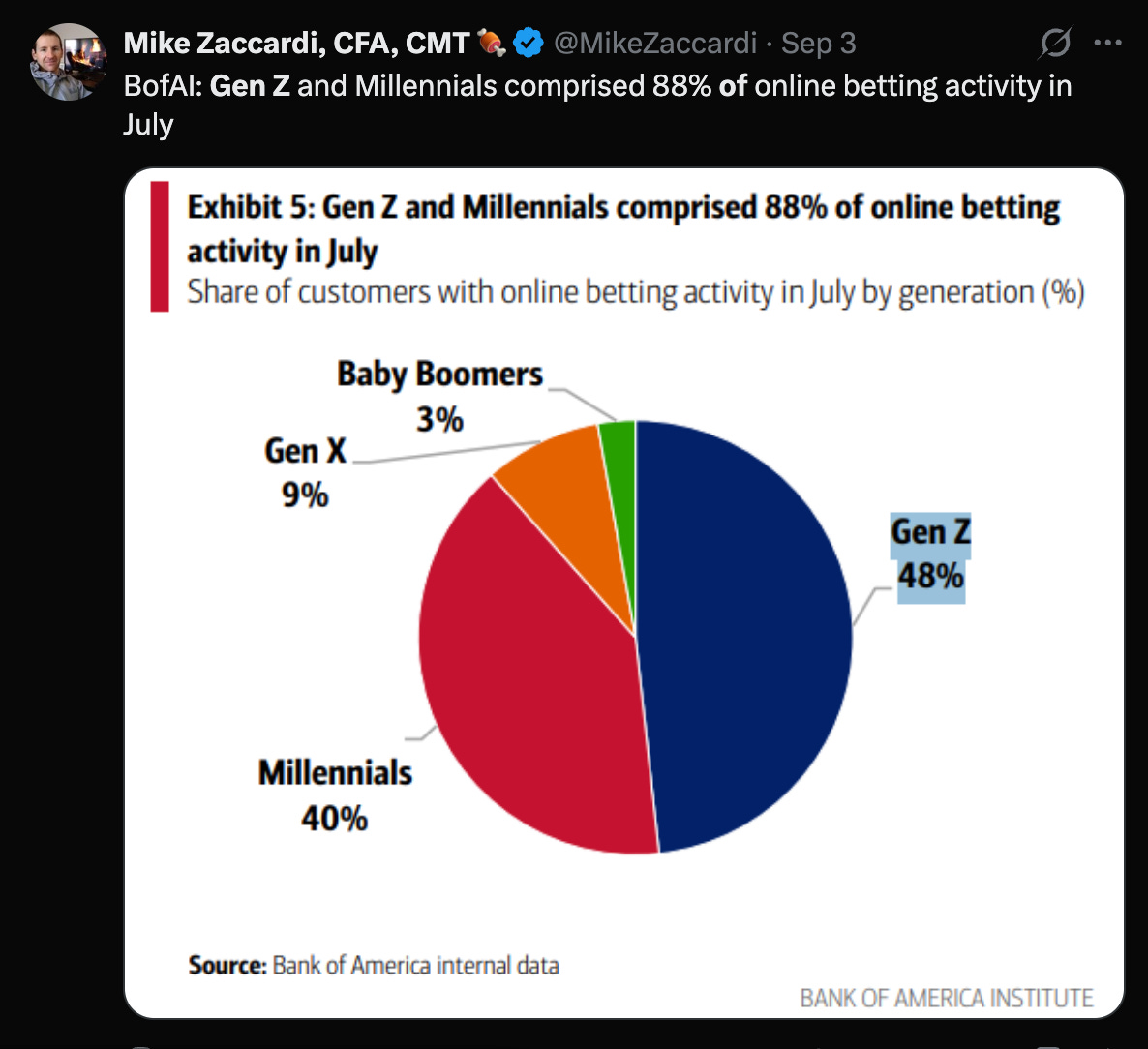
Gen Z and Millennials, Robinhood’s primary target demographic, seem much more prone to gambling and more speculative investing.
Additionally, as older people age, and pass down wealth to younger generations I would posit that a much greater % of older Gen Z/Millennials have Robinhood accounts vs. these conventional investment platforms.
With all of these effects, if Robinhood retains these customers as their wealth grows, I expect substantially more assets on the platform over time, as well as trading activity.
Risks
Before getting into the investment case, it’s important to highlight that much of Robinhood’s revenues are interest rate sensitive. Net Interest Income makes up 30% of revenues and is the primary selling point for Robinhood Gold subs. If the Fed cuts, Robinhood would take a hit across multiple revenue segments.
What Would Justify Today’s Price?
As you can probably tell, I imagine Robinhood becoming a much larger business over the next decade. What I’m struggling with is how much of that future I’m already being asked to pay for. That becomes harder when some of its fastest-growing businesses are ones I’m reluctant to underwrite.
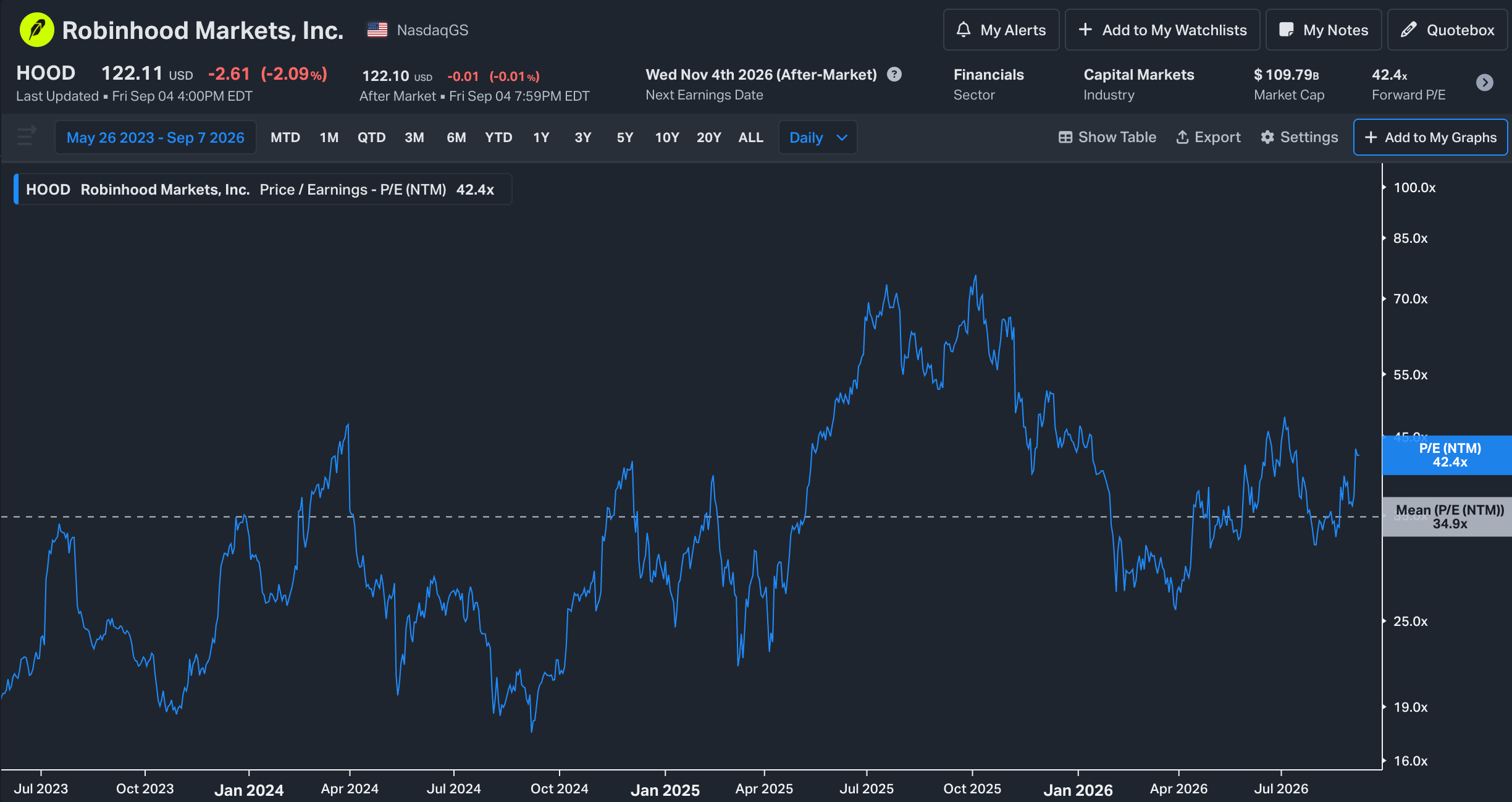
At present, they sit at a 42.4x forward price-to-earnings ratio, ~20% above their 3 year average PE ratio.
Instead of trying to guess at what each segment’s revenue will do over the next few years (you’ll find much better estimates of that from Wall Street analysts) I want to instead assume a future multiple, say in 2029 and work backwards to what their earnings would have to do to be a good investment from here.
Let’s start with the return threshold. For me, if we assume that investing in the broader market should give us ~10% annual returns on a nominal basis, I would like ~5% of additional annual return, giving me a 15% hurdle rate.
Now, let’s look at valuation ranges. I think it’s worth looking at 3 possible cases for this.
Robinhood has a 20x multiple in 2029. At half of the current multiple, it could bake in that the parabolic growth is done, and that the company is nearing maturity.
Robinhood has a 30x multiple in 2029. While it’s down from 2026, the company still has a positive sentiment in the market, and people think it will continue to do well.
Robinhood has a 40x multiple in 2029. Market sentiment is still overwhelmingly positive, and future prospects are strong.

At a 30x ending multiple, Robinhood would need to grow EPS by roughly 29% annually over three years to deliver my required 15% annual return. At 20x, the required EPS growth rises to nearly 48% annually. Even at 40x, EPS would need to grow around 17% per year.
If net profit margins and diluted share count stayed unchanged, revenue would need to grow at those same rates. Higher margins would reduce the revenue growth required, while additional share dilution would raise it.
Holding margins constant is definitely a simplifying assumption. Robinhood has already shown that it can grow revenue faster than expenses, as in 2025, revenue rose 52% while operating expenses increased 25%. If that operating leverage continues and translates into higher net margins, it could meet these EPS hurdles with less revenue growth than my table implies.
This makes it easier to assess Robinhood as an investment: am I comfortable with these growth assumptions?
To me, nearly 48% annual EPS growth, even with benefits from operating leverage, seems aggressive. The 29% and 17% hurdles seem more achievable, especially if margins continue to improve. But I still need to be comfortable with the combination of revenue growth and profitability required to get there.
Now, if we rewind the clock and look at what your assumptions need to be at a purchase price of $90/share, you can see the assumptions are much easier to underwrite.

We go from needing 29% annual EPS growth over the next 3 years to just 17% to get the same return on investment at a 2029 valuation of 30x 2030 EPS.
Takeaways & Action Plan
This exercise and its findings are why I stress the importance of entering a stock at a good valuation. The higher multiple a stock has, the more optimistic you have to be about its future prospects.
For me, to buy Robinhood at $120+ I’d need a clear-eyed view on what their long term margin profile will look like, and if the growth + margin expansion can support that EPS path I laid out.
For this reason I think the takeaway here for me is to add Robinhood to my watchlist, and keep an eye out for if it drops to ~$100 or below. However, if you have the brokerage cash available, selling a cash secured put might make sense. Looking at the April 2027 options chain, you can get ~$2400 in premiums currently selling one $120 strike put.

This puts your breakeven, or effective cost of owning the shares if assigned, at $96. Much closer to those $90 assumptions I laid out just a bit ago. Obviously, in this scenario you have to tie up $12,000 in capital, but if you’re a believer in Robinhood, this could make sense. If the put expires unexercised, you get your $12k back, and make ~20% over 220 days. The tradeoff here is that if something happens in the short term which materially hurts Robinhood, you’re going to be assigned at a higher price.
If you opt to wait, like I am, you can reassess before buying, but selling the put commits you to the trade. Additionally if Robinhood continues to run, you don’t get to participate in the upside. As always, this should not be treated as financial advice, and you should do your own due diligence. Options are inherently risky, and you should do more research than just reading this article before entering a position.
Enjoyed this article? Consider subscribing, leaving a comment, or check out my most popular posts:
How Much Should You Bet?

Position sizing is a conundrum. On one side, you can make a ton of small bets, and even if some go to zero, the odds are in your favor of having a favorable overall return. On the other end, you can make a few large bets, with the potential of outsized returns, while increasing the overall risk of ruin.
Commodity Futures Are Simple, Actually

Last Fall, I sat down in my Derivatives class fully expecting to feel like I did in AP Calculus back in high school. In over my head, totally confused, etc.