

Somehow it’s been four months since I’ve written specifically about Meta, despite feeling like it’s all I talk about. In today’s article I want to go over:
What I got right and wrong about Meta
How they are executing now (hint: very well)
Where I see them going in the future
What I got right and wrong so far:
Back in July, as part of an exercise I got from a great Michael Mauboussin article, I made a few predictions in a Google Doc about Meta. Here they are:
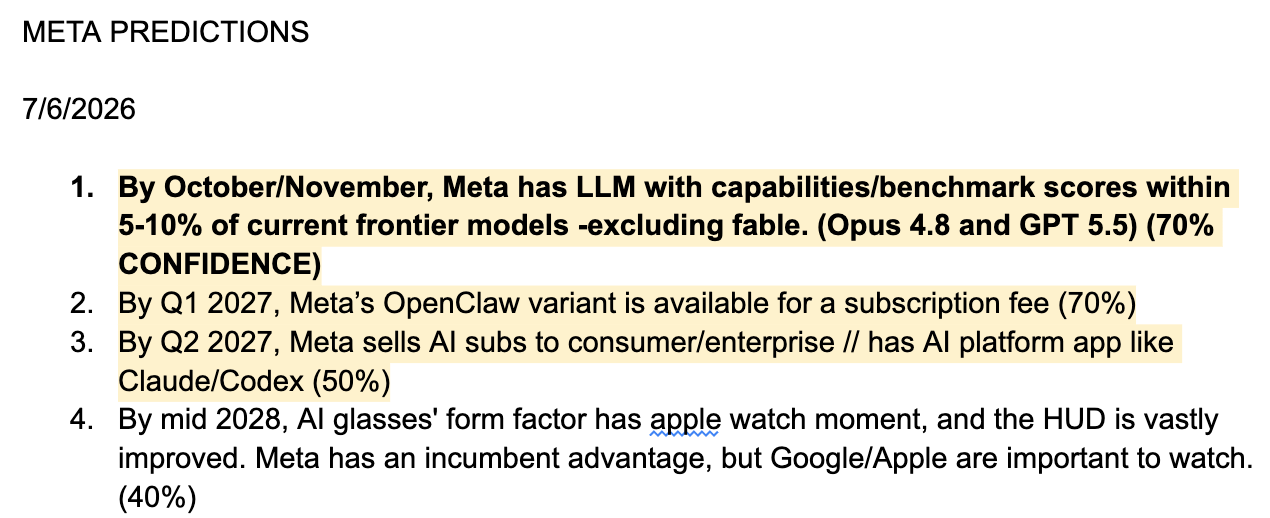
Instead of October/November, Muse Spark 1.1 released just three days later and was near/at the frontier.
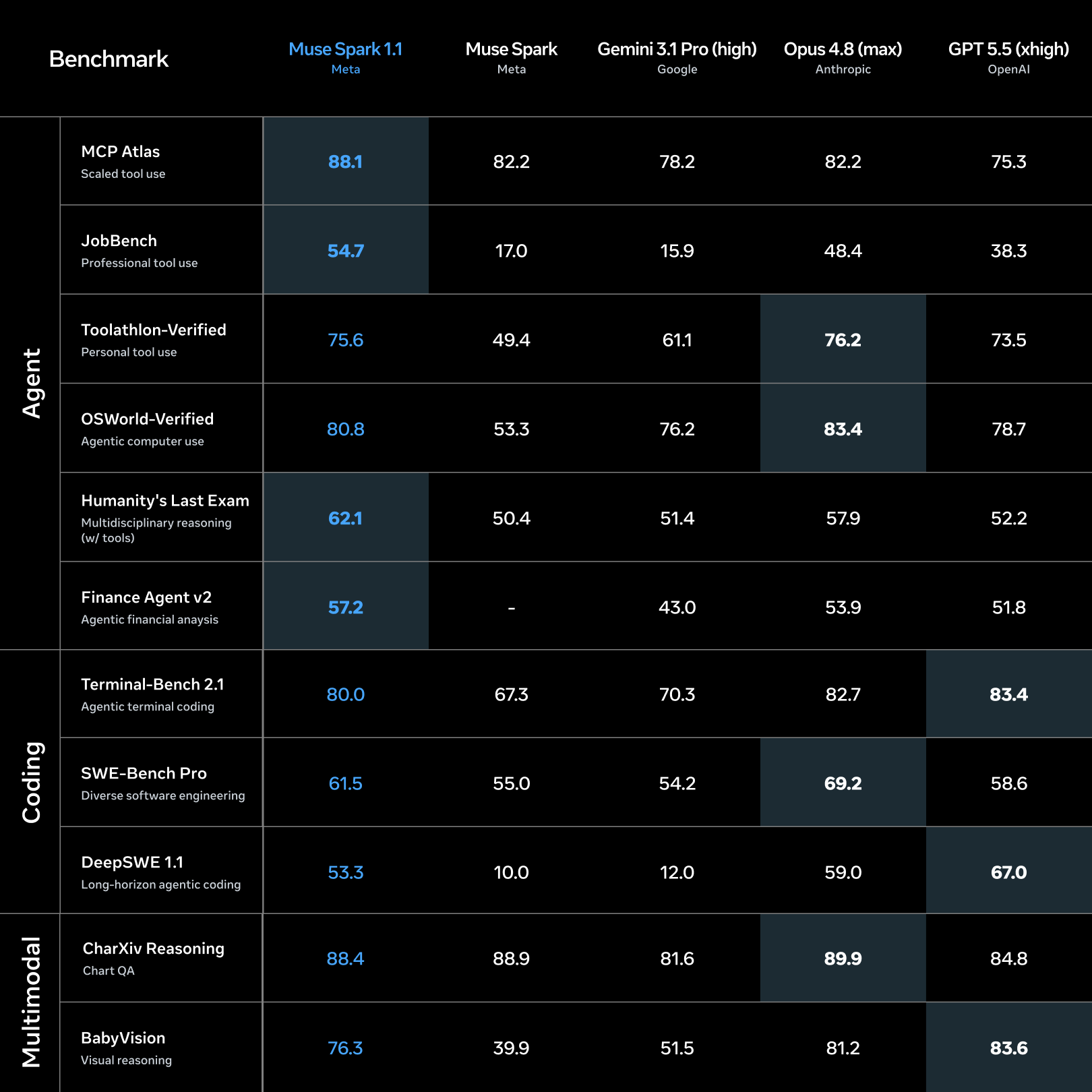
Instead of Q1 2027, Muse, Meta’s personal agent for consumers, launched on September 8th.


The third prediction has come to pass, but not how I envisioned it. They have opted for more of a usage-based model, serving Muse Spark 1.3 on platforms like Cursor and Muse Code. While I haven’t tried Muse Code specifically, I would like to see more seamlessness across Meta AI/Muse (the personal agent)/Muse Code. Right now it seems cluttered and messy.
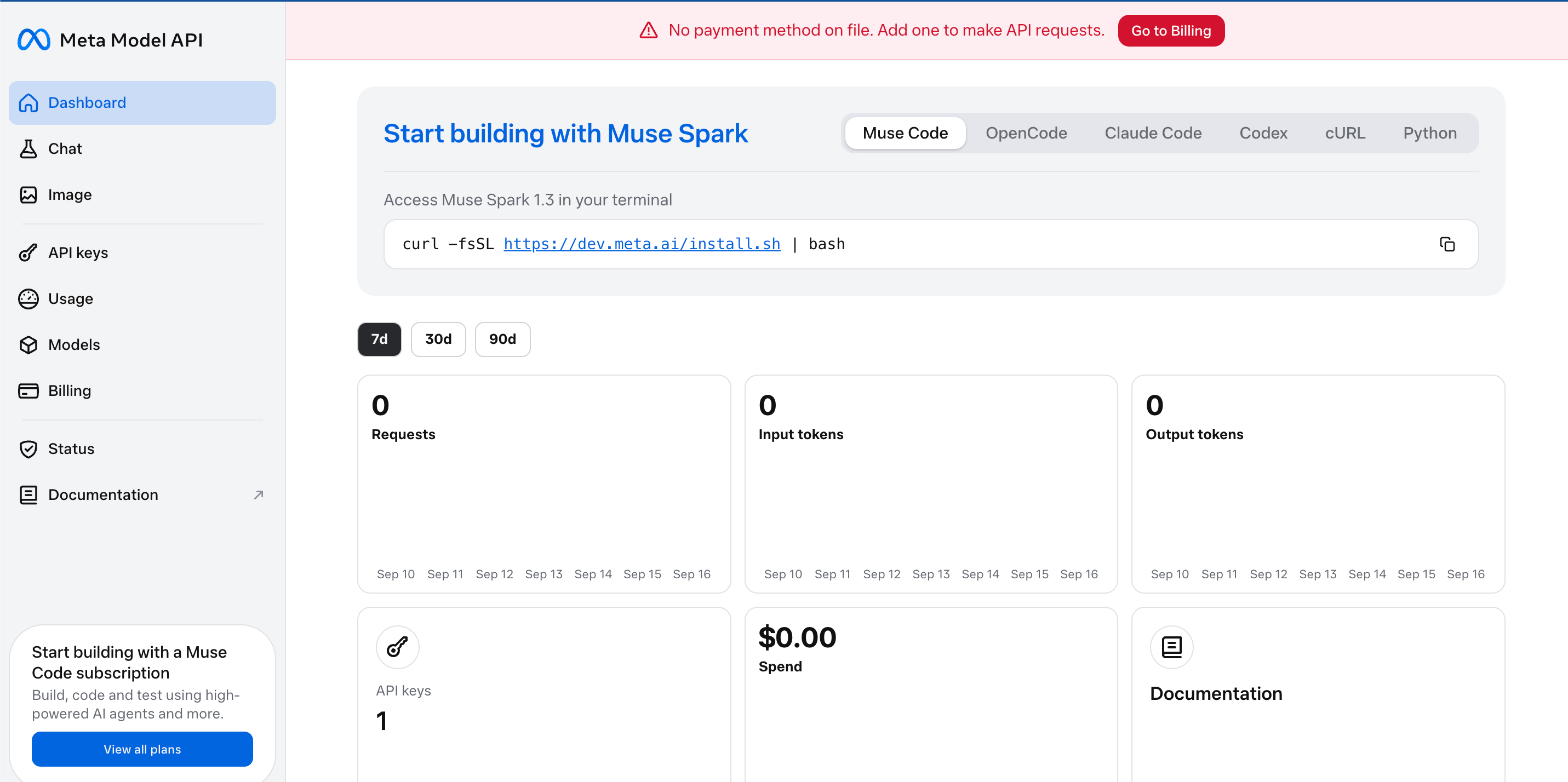
Just look at this interface compared with the likes of Claude Code & Codex. Those are much more user-friendly, straightforward and seamless with the base AI subscriptions you get with Claude and ChatGPT. As a completely non-technical person, I see some room for optimization & continuity across their AI products.
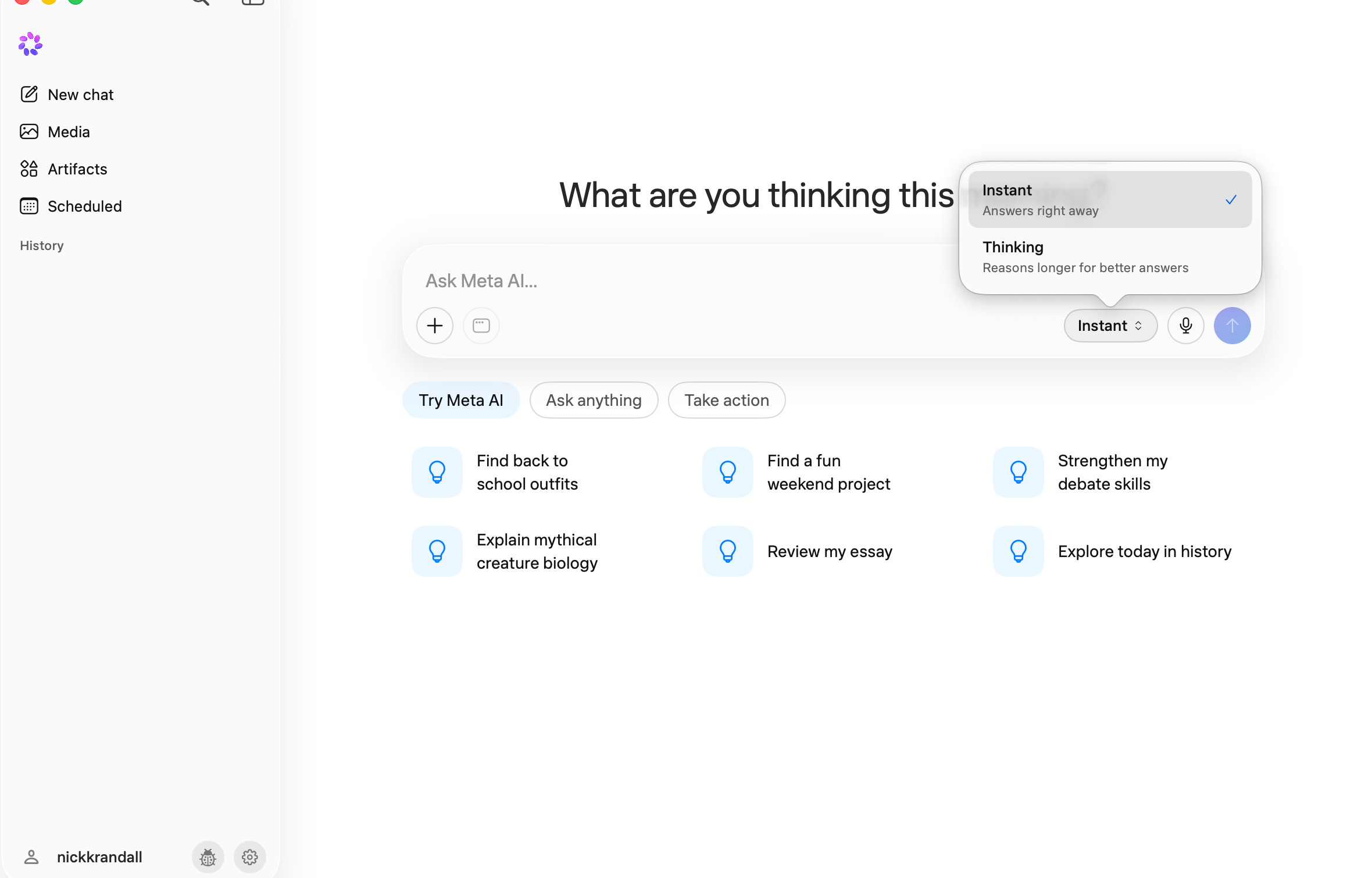
Additionally, why am I unable to pick between Muse Spark 1.1 and Muse Spark 1.3 on the standalone Meta AI app? Just seems like there is room for a Meta AI/Muse Code app merger of sorts.
These criticisms aside, I do want to give praise where it’s due, and that’s with Muse.
How Meta is Executing Now: Muse
I have been excited about the potential of a consumer-focused OpenClaw variant for some time now. Back in Q1 of 2026, everyone was buying Mac Minis to have an agent live on, where you could text it to help you book reservations or trips.
Now, Meta offers it as a free app. Aside from the price point of $0, it’s also a seamless user experience. I am very AI-forward, yet I would never take the time to set up a Mac Mini and have it host an agent for me. My mom, who has never used ChatGPT or Claude, was super excited to hear about an agent that could help book flights or hotels for cheaper.
Now I can download a free app to do what people were buying Mac Minis for just six months ago.
In short, I think OpenAI and Anthropic, while racing to win the enterprise, left the consumer behind. In their place, startups like Instinct and Poke demonstrated that there was demand for this sort of product. But with Muse, Meta has both the scale advantage & the model to deliver personal superintelligence and give you a virtual machine the agent can use to browse the web.
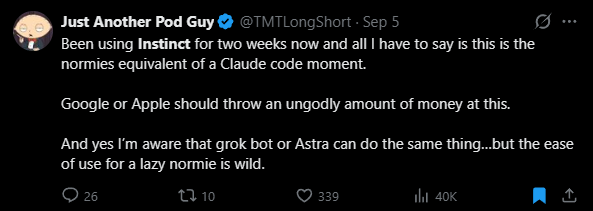
This allows you to do really cool things that are harder to do with ChatGPT and Claude. Or you can, but it burns through all your usage limits. Some use cases I have seen/enjoyed so far:
Texting Muse and having it schedule a DMV appointment for me
A periodic flight tracker that tracks prices for all my favorite destinations
A Twitter feed optimizer, finding the tweets it thinks I will care about the most, sorting through the engagement bait
Pay traffic citations
Finding underutilized subscriptions
Creating podcasts on interesting subjects
Calling AT&T to lower your bill (I don’t have access to this functionality yet but it will be a game changer once I get it)
There are countless other ways to use agentic AI, but overall giving away tons of free tokens plus access to a virtual machine allowed Muse to provide use cases that are significantly differentiated from current LLMs.
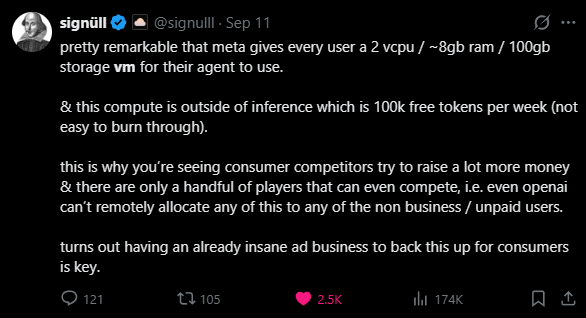
There are some interesting takeaways from this, namely the impending doom for businesses that rely on human laziness and complex cancellation flows. Your agent doesn’t get tired or lazy. If you tell it to cancel XYZ subscription, it just will.
Meta has really hit on something with this consumer-focused project, and while the path to monetization is not as clear as just selling tokens for $20/$100/$200/month, I think they can figure it out.
In a recent podcast, Zuckerberg specifically mentioned that there is potential to implement something of a take-rate business model where Meta could take a small percentage of money saved/made by Muse.
In addition to all of these positives, Meta has the benefit of having one of the best distribution vehicles possible. Instead of showing ads, they can advertise Muse to their 3.6 billion MAUs.
This distribution advantage is already showing up in the results. Just look at the download figures for Muse so far:


It’s also important to highlight their LLMs’ competitiveness in terms of pricing with other frontier models.
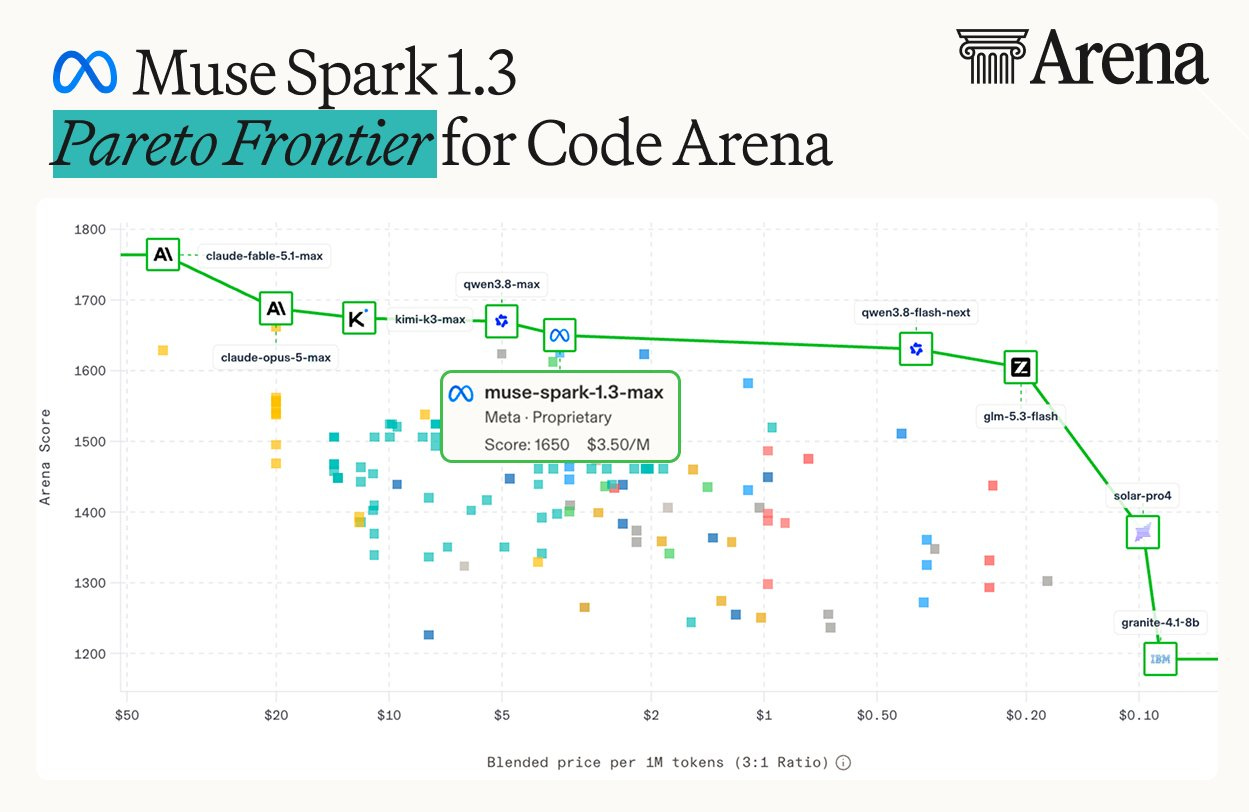
It’s even clearer to see this when we look at usage on OpenRouter, where Meta’s Muse Spark 1.3 has taken 43% share!
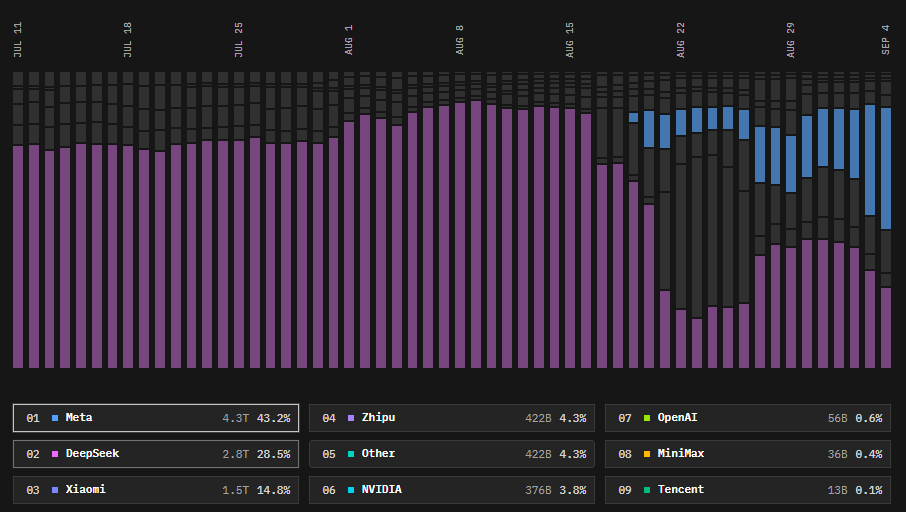
I am very curious to see how this continues, especially if Meta’s next model, Watermelon, has a major intelligence lead over GPT-6 Sol or Anthropic’s upcoming models, because we have seen Meta is willing and able to sell their tokens closer to their cost, significantly undercutting OpenAI and Anthropic for similar (or even higher) levels of intelligence.
This could be part of a strategy to hit OpenAI's and Anthropic's ARRs ahead of their upcoming IPOs and suck the air out of the room for further valuation rounds. This is a sound strategy considering we have seen a clear cycle emerge: more compute = stronger models = increased market share & revenues = easier equity raises = more $ for compute.
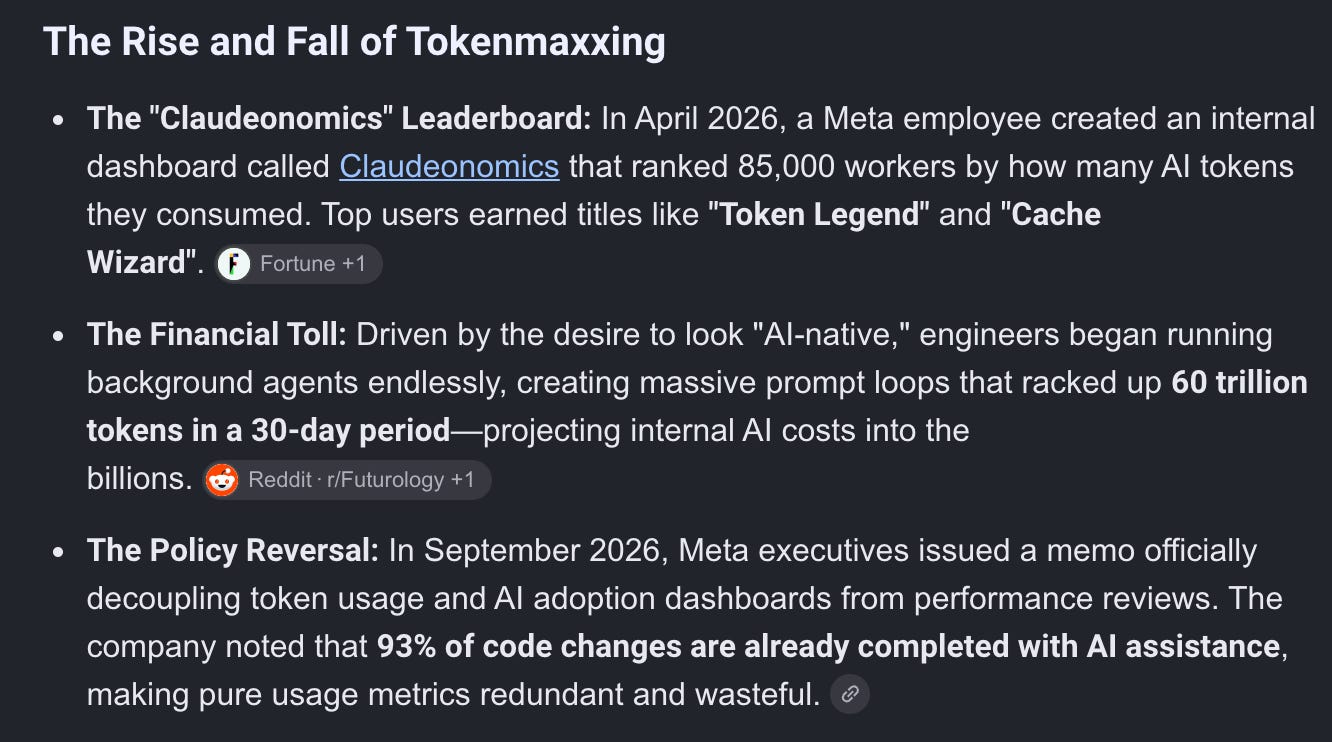
This has occurred at the same time that Meta has slowed their previous “tokenmaxxing” agendas and I would not be surprised to big customers’ spending being listed as a ‘Business Risk’ in Anthropic’s upcoming S-1 filing. A brief synopsis of the tokenmaxxing saga below:
What’s on the horizon?
This is all good to hear, and the pace at which Meta is iterating is very promising. But what’s more is that they are also not succumbing to the fear-mongering being pushed by the OpenAI/Anthropic cohorts. I thought this tweet from Zuck was pretty aggressive and I liked his rhetoric in response to the “pacing of the frontier” that Sam and Dario have recently called for.

The standout quote:
“Meta delayed shipping Muse for several months to focus on safety and security. We didn't call for everyone else to do this before we would. We just did it as part of our day-to-day work because it was clearly the right thing for people and for us. I'm proud of the security foundations we've built.”
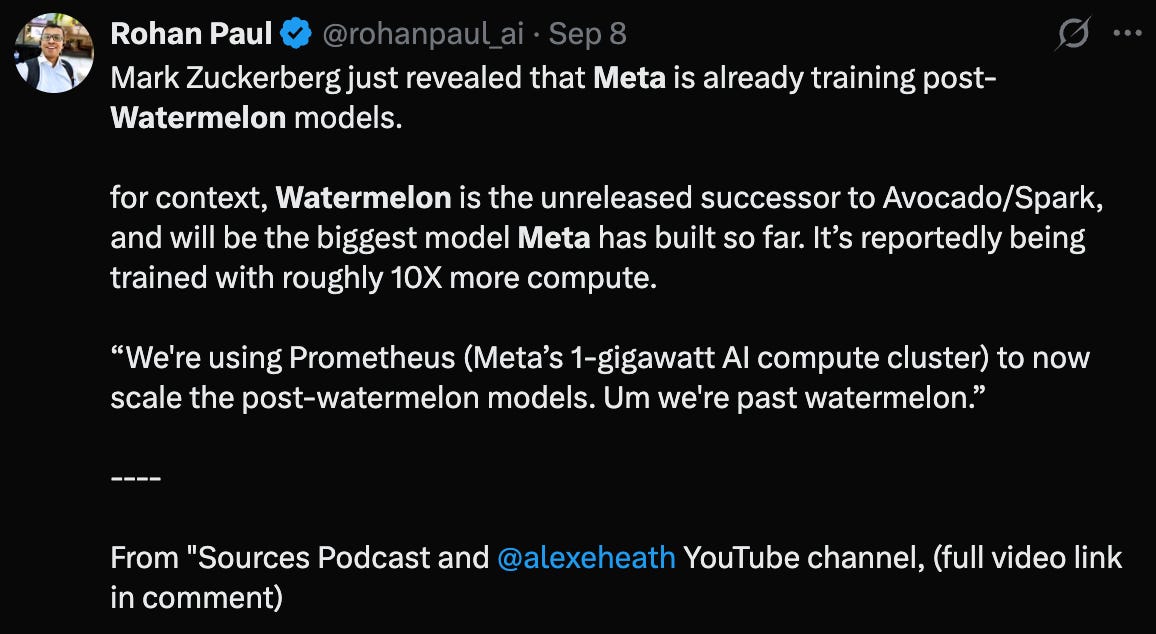
On the horizon, Meta is close to releasing Watermelon, and they've already begun work on the model after it. In addition to that, they have already begun work on the model after Watermelon.
What I hope to see from Meta is continued iteration on their AI product suite, and hopefully that can lead to re-rating upwards, as it feels like much of their underperformance in 2026 has been due to the market’s mistrust of their current capex policies.
Additionally, their Meta Connect event is just next week, and I expect that they will have even more positive developments there. I think there is a clear opportunity to have their models live on their wearables, and provide functionality where you can interface with Muse through voice.
If Muse adoption continues to be strong, and they can further monetize their investments in AI, I believe a sharp re-rate back to premium big tech multiples of 25-30x is well within the realm of possibility.
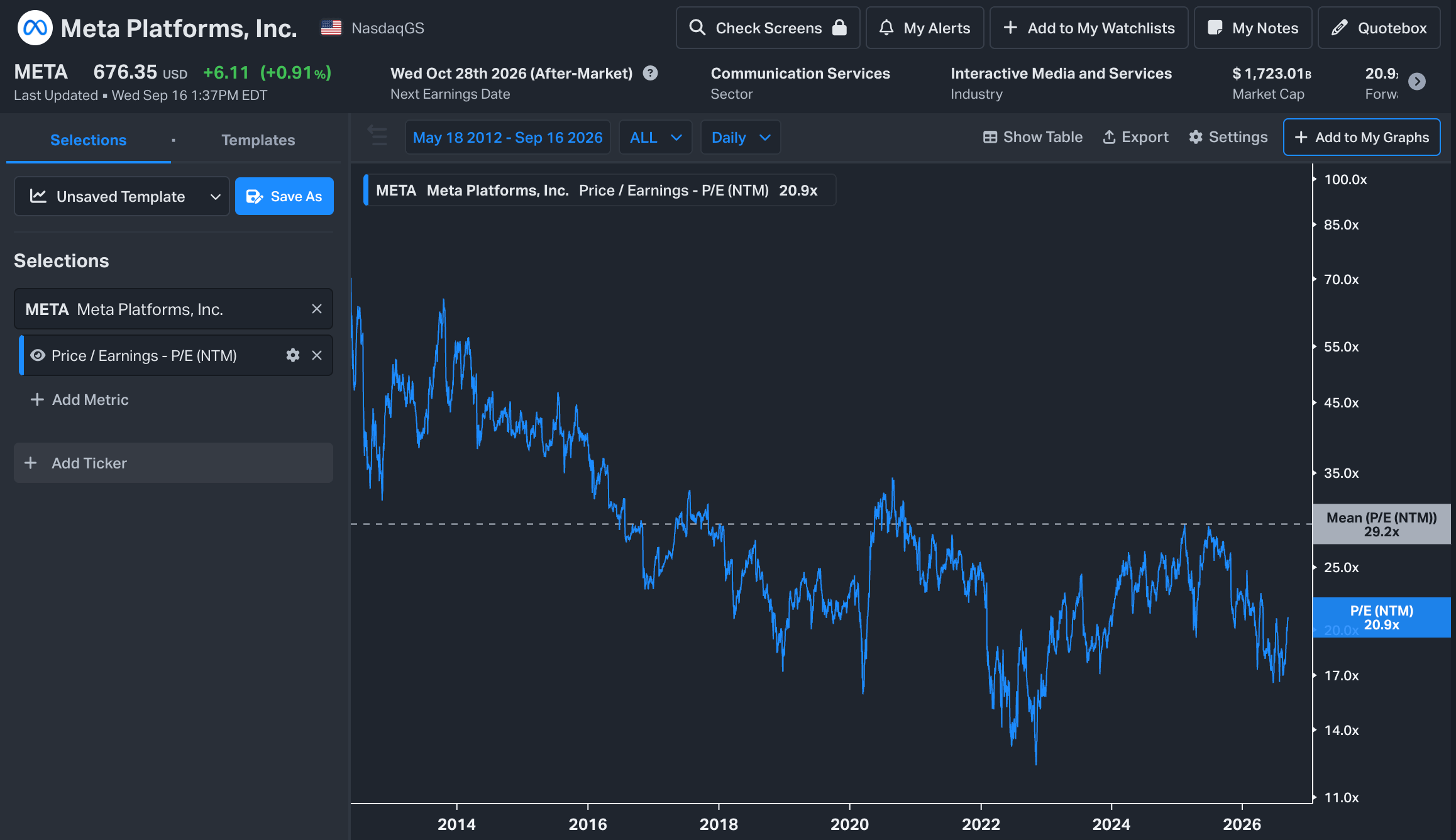
That, coupled with strong growth estimates for their core ad business is why I continue to view Meta as one of the best opportunities in the stock market right now.
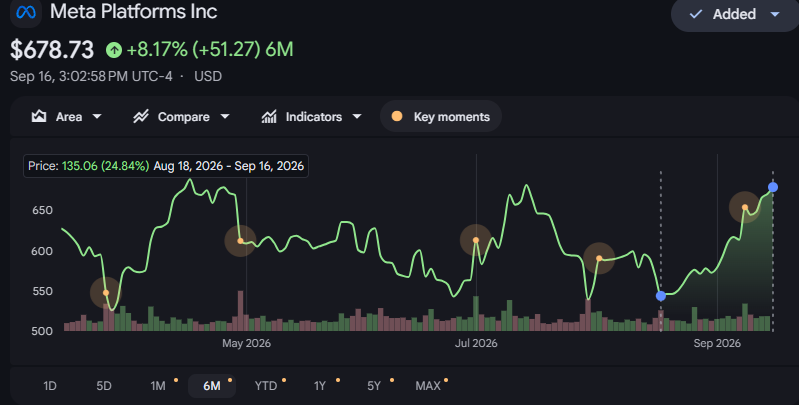
It does finally seem like some of Meta’s AI efforts are being appreciated, with the stock up ~25% since August 18th. My hope is that this is the beginning of a bigger move, as we have seen some previous moves like this fade over time.
Disclaimer:
I do hold investments in Meta Platforms.
This is not financial advice, do your own due diligence before making any investment decisions.

