

Price Anchoring Bias
Anchoring, specifically price-anchoring, is a cognitive bias where individuals rely too heavily on an initial piece of information (stock price) when making decisions.
We’ve all done it. “NVDA 0.00%↑ has gone up over 300%! It can’t keep going up.” Yet it did. From October 9, 2022 to November 5, 2023, Nvidia went up over 330%. Since then, it’s gone up another 273%.
The conservative thing to say was that it’s run up too much.
That’s pretty much how I thought about it at the time. It’s safe to say I am regretting that thought process.
But I think the stock market has provided an opportunity to right that wrong with two stocks, SK Hynix and Samsung. If you follow markets, you’ve likely seen or heard about SK Hynix’s performance over the last year. SK Hynix is up 375% in the past 12 months, and up 251% over the past 6 months alone.
The Story
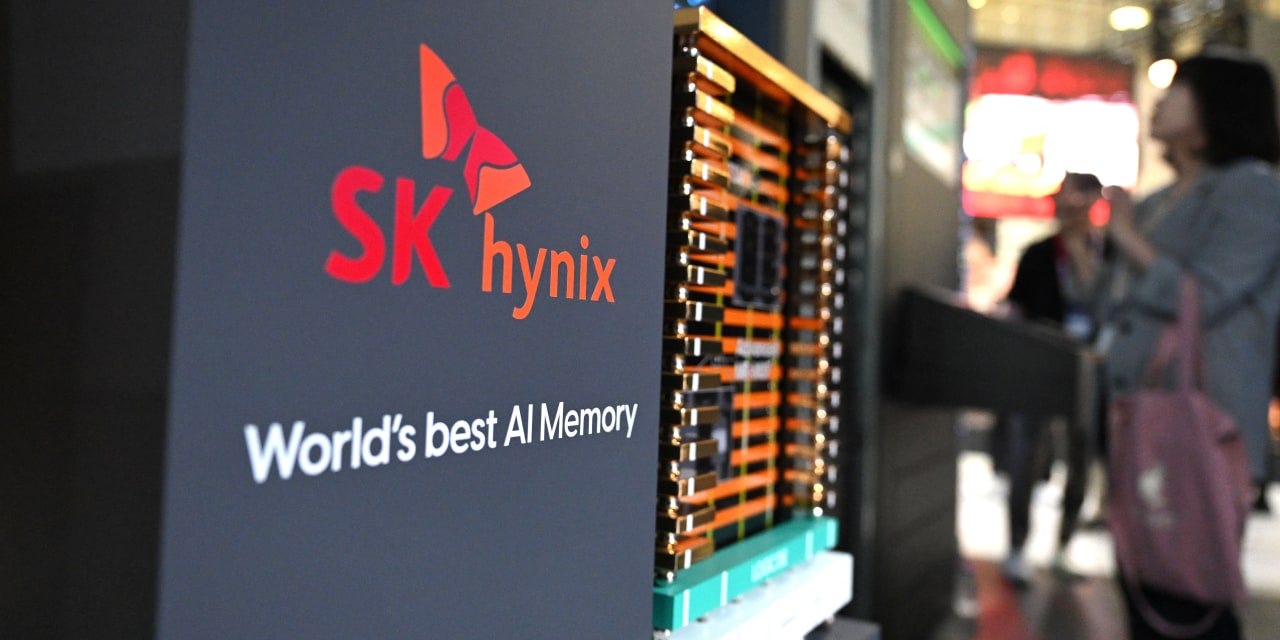
SK Hynix is the dominant supplier of HBM, (High Bandwidth Memory) controlling over 60% of the market. They are the primary supplier for Nvidia’s Blackwell and Rubin platforms.
In addition to HBM, SK Hynix produces DRAM and NAND Flash, both of which’s demand has increased significantly with the AI boom. DRAM contract prices are up roughly 170% year over year, and retail RAM kits (16-32gb) are up 240% over the past year.
Recently, even DDR4 and DDR3 ram prices have even surged as AI demand is actually extending into older DRAM models. SK Hynix has had to lower production of consumer DRAM to focus on AI memory, which is furthering this supply shock.
NAND Flash memory, which is behind the SSDs required for consumer PCs as well as data centers, have increased as well. A 1 terabyte NVMe drive that cost $65 in early 2025 is now retailing for over $130-$150.
SK Hynix, who develop and manufacture all of these products announced that their entire DRAM and NAND production capacity for 2026 was already sold out.
The CEO of Intel, Lip-Bu Tan, said today at the Cisco AI Summit that memory is the biggest constraint for AI right now, and that there is no relief til 2028. If someone on the inside of the AI boom is saying this, I think this makes a compelling argument for both SK Hynix and Samsung’s continued outperformance as the two clear leaders in the HBM and DRAM market.
While hyperscalers like Nvidia, Google, Amazon, are drivers of DRAM demand, AI video-generation of longer form content will ramp up demand for NAND flash storage that powers SSDs.
The typical Sora or Meta AI video is currently only 15-30 seconds long. Think about when those videos become 15 minutes to 1 hour in length, and they are being generated every second.
The Numbers
Morgan Stanley estimates Samsung’s 2027 operating profit to be $218.5 billion, which would make them the most profitable company in the world. Samsung’s current market cap is $771.67 billion, meaning that they are trading at roughly 3.5x 2027e operating profit. Quite cheap if you ask me!
Morgan Stanley estimates SK Hynix’s 2027 operating profit to be $155 billion, which would rank them with the likes of Mag-7 darlings Google, Meta, and Apple, while their market cap is only $455 billion. (2.9x 2027e operating profit)
If we assume that these figures from Morgan Stanley are accurate, and apply a 10-15x multiple to both Samsung and SK Hynix, they both provide attractive returns at their current levels.

For these reasons, I believe SK Hynix and Samsung will be the next two (non-IPO) companies to join the trillion-dollar market cap club, and that they both provide exceptional opportunities for returns over the next 2-3 years.
The Trade
The difficulty in this trade is actually not in the thesis or financial projections, I actually think it is in execution. Currently there are no US-based listings for Samsung or SK Hynix. This means that in order to gain exposure to these two companies, your options are somewhat limited.
